Read in: English | हिंदी
By Team Ishkol · 1 November 2026
Is your child in Class 10 this year? Then here is the most important thing to know about the CBSE two board exams system: the February exam is compulsory for every student, and a second exam in May is optional, for improving marks in up to three main subjects. CBSE keeps the better of the two scores. The system ran for the first time in 2026, and the 2027 cycle has already begun. This guide explains the rules, what the first year showed, and how families can use the second chance without doubling the stress.
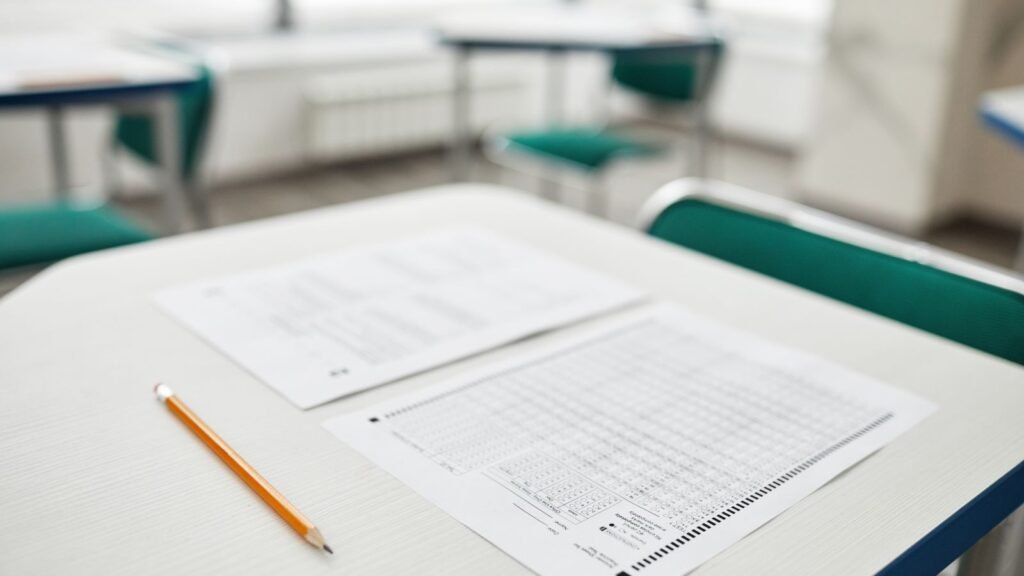
Why does CBSE now hold two board exams for Class 10?
The idea comes from the National Education Policy (NEP) 2020. Paragraph 4.37 says board exams will be made “easier” and, to remove their “high stakes” nature, students should be allowed to take board exams on up to two occasions in a school year: one main examination and one for improvement, if desired. CBSE quotes this paragraph in its draft scheme, released for public feedback on 25 February 2025.
In June 2025 CBSE approved the scheme for Class 10 from 2026. As reported by PTI on 25 June 2025, the first phase is held in February and the second in May, and results come out in April and June respectively. As it turned out, the 2026 second-exam results came out in July (more on that below).
CBSE two board exams: the key rules for parents
The details below come from CBSE’s official notification of 14 February 2026 and its press release of 18 July 2026.
- The first exam (February) is compulsory. CBSE says it is “mandatory for all the students to appear in the first Board examination.”
- The second exam (May) is optional. A student who has passed can use it to improve performance in up to three subjects from Science, Mathematics, Social Science and Languages.
- The better score counts. For regular students, CBSE counts the better of the two performances.
- It also works as the “compartment” chance. Students who need to clear a subject appear in the second exam under the compartment category, so there is no separate supplementary exam in July any more.
- Missing the first exam has a cost. A student who does not appear in three or more subjects in the first exam cannot take the second exam. They are placed in the “Essential Repeat” category and take the main exam the next February.
- Only Class 10. So far the two-exam system applies to Class 10 only. We found no CBSE notice extending it to Class 12.
What about Class 11 admission and internal assessment?
According to the PTI report on the approved scheme, internal assessment is done only once in the school year, not twice. CBSE’s draft scheme also proposed that Class 11 admission can go ahead on the basis of the first exam’s results, which are made available in DigiLocker. Because this point is from the draft, check the final arrangement with your child’s school.
What happened in the first year (2026)?
The 2026 main exam ran from 17 February to 11 March, and the second exam from 15 to 21 May. CBSE announced the second-exam results on 18 July 2026. Its press release gives a clear picture of how families used it:
- 6,63,777 students appeared in the second exam (6,64,027 registered).
- 5,13,955 appeared to improve their marks, and 3,08,095 of them (59.95%) did better than in the main exam.
- In the compartment category, 1,49,822 appeared and 78,503 passed (52.40%), compared with 48.68% in 2025.
- Taking both exams together, the overall pass percentage was 96.78%.
Two lessons stand out. First, the second chance is real: about six in ten students who tried to improve did improve. Second, about four in ten did not, so the May exam is a safety net, not a shortcut. The best results still come from steady preparation for February.
Where things stand for the 2027 board exams
CBSE’s press release of 29 September 2026 confirmed that schools had started submitting the List of Candidates (LOC) for the 2027 Class 10 and 12 exams. Careers360 reported that the LOC for the first exam covers all students, while the LOC for the second exam is submitted separately after the first exam. As of the end of October 2026, CBSE had not yet released the 2027 date sheet. Keep an eye on cbse.gov.in and your school’s notices, and check that your child’s name, subjects and date of birth are correct in the LOC.
What parents can do
- Plan for February, not May. Treat the first exam as the real exam. The second exam is a backup, and only for up to three subjects.
- Make a simple monthly plan now. November to January: finish the syllabus and revise once. January: practise full papers with a timer. Small daily study beats last-minute cramming. Our guide to 7 study habits that help school students learn better has easy routines.
- Decide about the second exam calmly, after the result. Sit with your child and the teacher. Ask: which subject is clearly below your child’s ability? Is there enough time to prepare? Will it affect Class 11 subject choices?
- Watch for signs of stress. Changes in sleep, appetite, mood or a loss of interest in friends deserve attention. Keep talking, keep sleep and meals regular, and keep some time for play or a hobby. If worry continues, speak to the school counsellor or a doctor.
- Use the official helpline. In 2026 CBSE ran free psycho-social counselling for students and parents, including a toll-free 24×7 line, 1800-11-8004, in Hindi and English (CBSE release, 6 January 2026). Check CBSE’s website for the 2027 counselling schedule.
- Avoid comparison. Talking about a cousin’s or neighbour’s marks rarely helps. Praise effort and progress.
What teachers can do
- Explain the rules early at a parent-teacher meeting, especially that the first exam is compulsory and that missing three or more subjects rules out the second exam.
- Run a “diagnostic” pre-board and share subject-wise feedback, so families can make an informed choice about the May exam later.
- Teach exam skills, not just content: reading the question carefully, time planning, and writing clear steps in maths and science.
- Keep an eye on wellbeing and connect worried students with the school counsellor.
Younger brothers and sisters can benefit too. The habits that make board exams easier are built much earlier, starting with strong reading and maths in primary school. See our guide on how parents can help kids read.
FAQ: CBSE Class 10 second board exam
Is the second CBSE board exam compulsory?
No. The first exam in February is compulsory for all students. The second exam in May is optional.
How many subjects can be improved in the second exam?
Up to three subjects from Science, Mathematics, Social Science and Languages, according to CBSE’s notification of 14 February 2026.
Which marks count if my child takes both exams?
For regular students, CBSE counts the better of the two performances.
What if my child misses the first board exam?
A student who misses three or more subjects in the first exam cannot take the second exam and is placed in the “Essential Repeat” category, taking the main exam the following February.
Does the two-exam rule apply to Class 12?
Not as of November 2026. CBSE’s two-exam system is for Class 10 only.
Sources
- CBSE: Draft scheme for two board examinations in Class X, quoting NEP 2020 para 4.37 (25 February 2025)
- The Week / PTI: CBSE approves two board exams for Class 10 from 2026 (25 June 2025)
- CBSE: Notification on two board examinations in Class X (14 February 2026)
- CBSE: Press release on Class X second board examination results (18 July 2026)
- CBSE: Press release on LOC submission for 2027 (29 September 2026)
- Careers360: CBSE 2027 LOC submission dates and process (23 September 2026)
- CBSE: Psycho-social counselling for students (6 January 2026)
Want steady, stress-free preparation with real teachers? Explore Ishkol Pathshala and our resources for parents, or visit our centres in Najafgarh (New Delhi) and Port Blair.