Every Dussehra, we watch Ravana burn and celebrate the victory of good over evil. Ravana had ten heads. This year, try thinking of each head as a bad habit that lives inside all of us. Lying, anger, greed, laziness and the rest are not monsters. They are small choices we repeat until they become habits. The good news is that habits can be changed, one choice at a time.
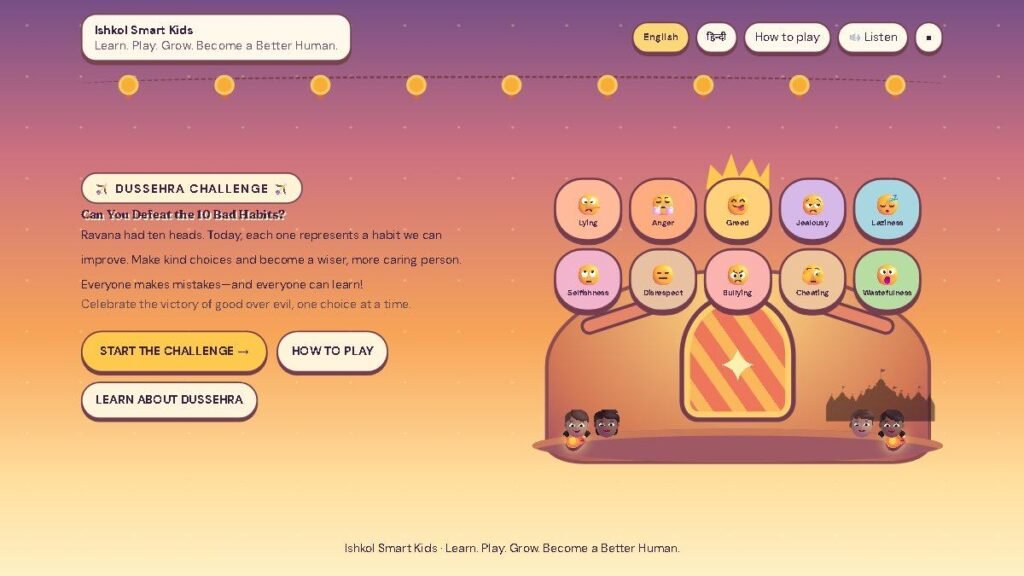
This guide is for children, parents and teachers. It explains the ten bad habits, the good habit that can replace each one, and one small step you can try this week. You can also play the free Dussehra Challenge game made by Ishkol Smart Kids.
Everyone makes mistakes, and everyone can learn
A good person is not someone who never gets angry or never tells a lie. A good person notices the mistake, says sorry and tries again. That is why we talk about habits, not bad children. When a child hears “you are a liar”, they feel stuck. When they hear “lying is a habit, and you can change it”, they feel hopeful.
The 10 bad habits and how to defeat them
1. Lying → Honesty
We often lie because we are scared of being scolded. Try this: when you make a mistake, say what happened first, before anyone asks. Telling the truth gets easier every time you do it.
2. Anger → Calm
Feeling angry is normal. Hurting someone because of it is not. Try this: when you feel angry, stop, take five slow breaths and count to ten before you speak.
3. Greed → Sharing
Greed says “I want more, and only for me.” Try this: share one thing every day, such as your tiffin, your colours or your time.
4. Jealousy → Celebrating others
Jealousy makes us unhappy when someone else does well. Try this: when a friend wins, say “well done” and mean it. Then ask them how they did it. Their success can teach you something.
5. Laziness → Effort
Laziness grows when a task looks too big. Try this: start with just five minutes. Once you begin, it is usually easier to keep going. Our post on 7 study habits that help students learn better has more ideas.
6. Selfishness → Kindness
Selfishness thinks only about “me”. Try this: do one kind thing every day without being asked. Help at home, carry someone’s bag, or sit with a classmate who is alone.
7. Disrespect → Respect
Disrespect hurts parents, teachers, elders and friends. Try this: use “please”, “thank you” and “sorry” every day, and listen fully when someone is speaking to you.
8. Bullying → Friendship
Teasing, pushing or leaving someone out can make school a frightening place. Try this: if you see someone being bullied, stand next to them and tell a teacher. If you have teased someone, say sorry and invite them to join your game.
9. Cheating → Fair play
Cheating may get you marks, but it does not give you learning. Try this: before a test, practise on your own with free worksheets and quizzes. When you are prepared, you do not need to cheat.
10. Wastefulness → Caring for things
Wasting food, water, paper or electricity is a habit too. Try this: take only as much food as you can eat, turn off the tap and the fan when you leave, and use both sides of the paper.
How to change any habit in four steps
- Notice it. Pick one habit and watch when it happens. Is it when you are tired, hungry or scared?
- Replace it. Decide what you will do instead. Five breaths instead of shouting. The truth instead of an excuse.
- Repeat it. A new habit needs practice every day. Missing a day is fine. Start again the next day.
- Celebrate it. Mark each good day on a chart. Small wins add up.
Do not try to fix all ten habits at once. Choose one this week and one next week. Ravana’s ten heads did not fall in a single moment, and our habits will not either.
Play the Dussehra Challenge
Ishkol Smart Kids made a free game to go with this guide. Children make kind choices to defeat each of Ravana’s ten bad-habit heads. It is free to play in English or Hindi, and the Listen button reads it aloud for younger children.
For parents
Children learn habits by watching us. If we say sorry when we are wrong, they learn to say sorry too. Play the game together this Dussehra, then ask your child which head they want to defeat first. Make a simple chart with ten boxes, one for each habit, and tick a box each time your child picks the good habit. Praise the effort, not just the result. You can find more ideas on our page for parents.
For teachers
The game works well as a morning assembly or a value education period. Play it on a projector, let the class vote on each answer, and then ask students to write one habit they will work on this month. For more classroom activities and teacher resources, visit Master Ji, Ishkol’s space for teachers.
Common questions
How long does it take to change a bad habit?
It is different for every person and every habit. What matters is practising the new habit every day, even on days you slip.
What should I do if my child keeps lying?
Stay calm and make it safe to tell the truth. Thank your child when they are honest, even about a mistake, and talk about the mistake separately. Children lie less when the truth does not lead to shouting.
What age is the Dussehra Challenge game for?
It is made for school children, and younger children can play with a parent or teacher. The ideas in it are useful at any age.
This Dussehra, let us burn one bad habit along with Ravana. Choose one, practise the good habit every day, and celebrate every small victory. Every child can learn, and every child can become a better human. Explore more fun learning at Ishkol Smart Kids and our free learning page.
Keep learning with Ishkol
Free worksheets, quizzes, games and videos for every class. Pick one and start today.